ERP for Manufacturing: How Manufacturing ERP Software Improves Production Efficiency
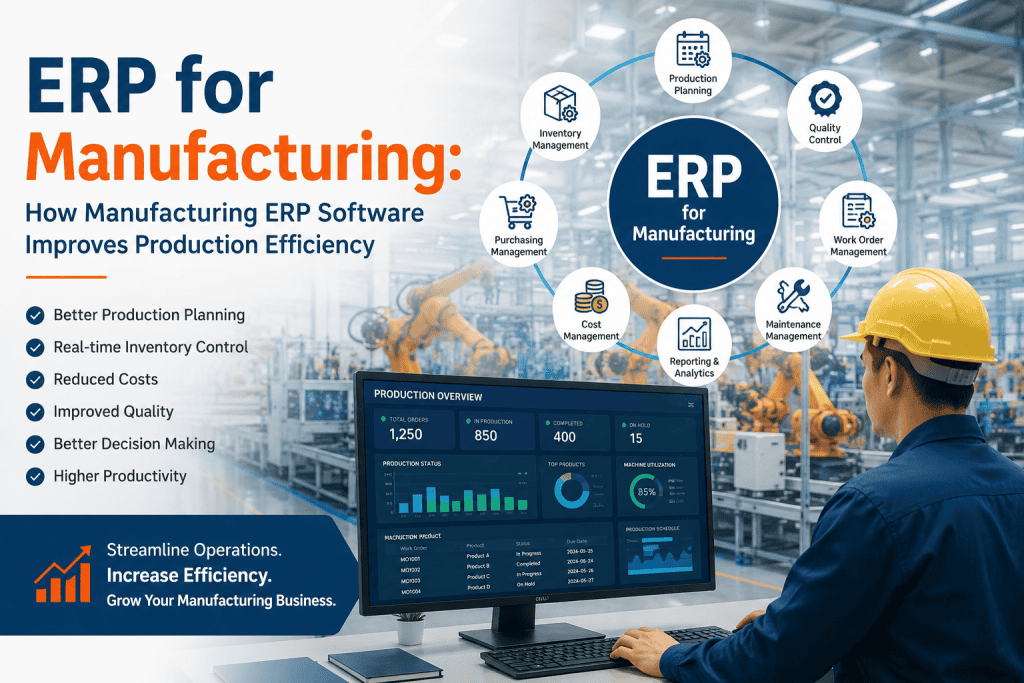
Manufacturing businesses need to manage production, inventory, purchasing, sales, employees, quality control, and financial operations at the same time. Managing these processes manually or using disconnected software can lead to production delays, inventory shortages, inaccurate data, and higher operating costs.
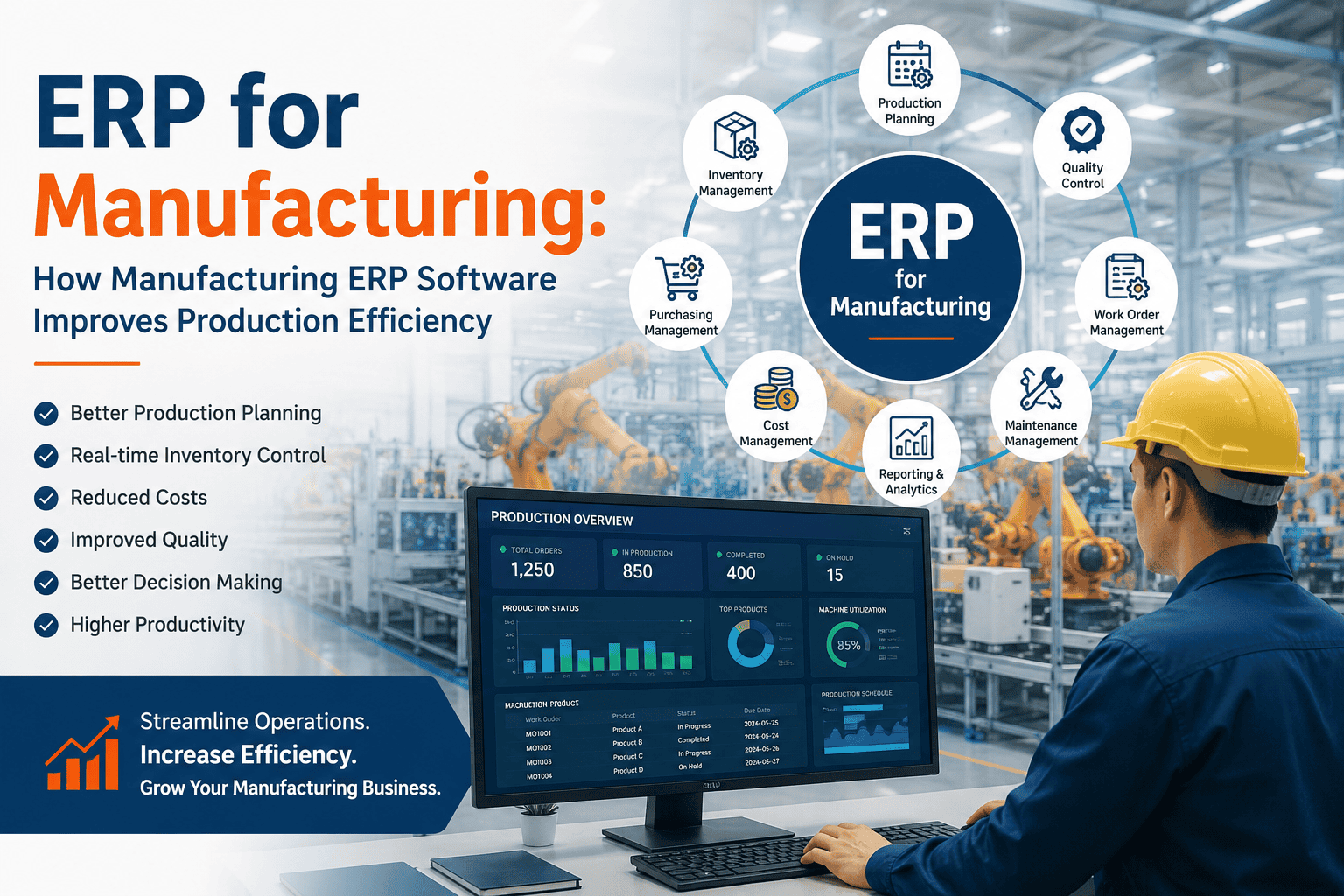
ERP for Manufacturing provides an integrated solution that connects different business processes in one centralized system. Manufacturing ERP software helps businesses plan production, manage raw materials, monitor inventory, track manufacturing orders, control costs, and make better business decisions using real-time data.
In this guide, we will explain what manufacturing ERP is, its key features, benefits, and how it can improve manufacturing operations.
What Is ERP for Manufacturing?
ERP for Manufacturing is an enterprise resource planning system specifically designed to manage and integrate manufacturing operations.
Unlike basic accounting or inventory software, a manufacturing ERP connects multiple departments and processes, including:
- Production planning
- Manufacturing orders
- Inventory management
- Purchasing
- Sales
- Bill of Materials (BOM)
- Work orders
- Quality control
- Maintenance
- Accounting
- Employee management
- Reporting and analytics
Instead of maintaining separate systems for each department, manufacturers can use one integrated platform to manage their entire operation.
For businesses looking for a broader understanding of ERP systems, see our complete guide to ERP Software in Bangladesh.
Why Do Manufacturing Businesses Need ERP Software?
Manufacturing operations involve many interconnected activities. A small problem in one area can affect the entire production process.
For example, if the purchasing department does not know the current inventory level, the business may order too many or too few raw materials. If production does not have accurate sales information, production planning can become inefficient.
A manufacturing ERP solves these problems by connecting business data across departments.
Common problems without a Manufacturing ERP
Manufacturers often face:
- Manual data entry
- Inventory inaccuracies
- Production delays
- Raw material shortages
- Overstocking
- Poor production planning
- Difficult cost tracking
- Lack of real-time information
- Communication problems between departments
- Limited reporting capabilities
An ERP system helps centralize this information and automate many repetitive processes.
Key Features of Manufacturing ERP Software
A good manufacturing ERP should provide features that support the complete production lifecycle.
1. Production Planning
Production planning helps manufacturers determine what needs to be produced, when it needs to be produced, and what resources are required.
ERP software can help businesses:
- Schedule production
- Plan manufacturing orders
- Allocate resources
- Monitor production progress
- Identify production bottlenecks
Better production planning can help reduce downtime and improve operational efficiency.
2. Bill of Materials (BOM)
A Bill of Materials defines the raw materials, components, and quantities required to manufacture a product.
For example, a manufacturer producing a table may require:
- Wood
- Screws
- Metal components
- Paint
- Packaging materials
The ERP system can use the BOM to calculate material requirements and support production planning.
3. Inventory Management
Inventory management is one of the most important components of manufacturing ERP software.
The system can track:
- Raw materials
- Work-in-progress inventory
- Finished products
- Stock movements
- Warehouses
- Stock levels
- Reordering requirements
Real-time inventory visibility helps manufacturers avoid unnecessary stock shortages and excess inventory.
4. Work Order Management
Work order management allows businesses to organize and monitor individual production activities.
Manufacturers can track:
- Work centers
- Production stages
- Machine usage
- Labor requirements
- Production time
- Work order status
This makes it easier to identify where production is slowing down.
5. Purchase Management
Manufacturing companies depend heavily on suppliers for raw materials and components.
Manufacturing ERP software can connect purchasing with inventory and production requirements.
Businesses can:
- Create purchase orders
- Manage suppliers
- Track incoming materials
- Monitor purchase costs
- Automate replenishment
This helps ensure that required materials are available when production needs them.
6. Quality Management
Quality control is critical in manufacturing.
An ERP system can help businesses establish quality checkpoints throughout the production process.
Quality management may include:
- Incoming material inspections
- Production quality checks
- Finished product inspections
- Quality alerts
- Defect tracking
- Quality reports
This can help manufacturers identify problems earlier and reduce defective products.
7. Maintenance Management
Manufacturing companies depend on machines and equipment. Unexpected machine failures can cause significant production downtime.
ERP software with maintenance functionality can help companies schedule:
- Preventive maintenance
- Corrective maintenance
- Equipment inspections
- Maintenance requests
- Machine service schedules
This helps businesses maintain equipment and reduce unexpected downtime.
8. Manufacturing Cost Management
Manufacturers need accurate information about production costs to maintain profitability.
ERP systems can help track costs related to:
- Raw materials
- Labor
- Machine operations
- Production overhead
- Purchasing
- Manufacturing processes
With better cost visibility, management can make more informed pricing and production decisions.
Benefits of ERP for Manufacturing
Implementing an ERP system can provide several operational and financial benefits.
Improved Production Efficiency
By integrating production planning, inventory, purchasing, and work orders, manufacturers can reduce unnecessary delays and improve workflow efficiency.
Better Inventory Control
Real-time inventory information helps businesses maintain appropriate stock levels and reduce the risk of material shortages.
Reduced Manual Work
ERP automation can reduce repetitive data entry and administrative tasks.
Better Decision-Making
Management can access centralized reports and real-time business data instead of relying on spreadsheets and disconnected systems.
Improved Production Visibility
Managers can monitor production orders, work centers, inventory, and manufacturing activities from a centralized platform.
Lower Operational Costs
Better planning, inventory management, and resource utilization can help reduce unnecessary operational expenses.
Improved Customer Service
When businesses have better visibility into inventory and production schedules, they can provide customers with more accurate delivery information.
Manufacturing ERP vs Traditional Software
Traditional manufacturing businesses may use separate applications for accounting, inventory, purchasing, production, and sales.
This creates disconnected data.
A manufacturing ERP integrates these processes into one system.
| Area | Traditional Software | Manufacturing ERP |
|---|---|---|
| Production | Separate system | Integrated |
| Inventory | Limited visibility | Real-time visibility |
| Purchasing | Often disconnected | Connected with inventory |
| Accounting | Separate | Integrated |
| Production Planning | Manual or limited | Centralized |
| Reporting | Multiple data sources | Centralized data |
| Automation | Limited | Higher automation |
The main advantage of ERP is not simply having more features. It is connecting business processes and data together.
How Manufacturing ERP Works
A typical manufacturing ERP workflow may look like this:
Sales Order → Production Planning → Material Requirement → Purchase/Inventory → Manufacturing Order → Work Orders → Quality Control → Finished Goods → Delivery → Accounting
Because these processes are connected, information can automatically move between departments.
For example, when a production order requires additional raw materials, the system can identify the inventory requirement and support the purchasing or replenishment process.
ERP for Small and Medium Manufacturing Businesses
Manufacturing ERP is not only for large factories.
Small and medium-sized manufacturers can also benefit from ERP software, particularly when they have:
- Multiple products
- Multiple warehouses
- Complex production processes
- Large inventories
- Multiple suppliers
- Growing customer orders
- Increasing operational complexity
However, small businesses should avoid implementing an unnecessarily complicated ERP system.
The best solution should match the company’s current requirements while allowing room for future growth.
How to Choose the Best ERP for Manufacturing
Before selecting manufacturing ERP software, businesses should evaluate several factors.
1. Manufacturing Features
Check whether the system supports BOMs, manufacturing orders, work orders, production planning, quality management, and inventory.
2. Scalability
The ERP should be capable of supporting business growth without requiring a complete system replacement.
3. Customization
Different manufacturing industries have different workflows. The ERP should provide sufficient flexibility for customization when required.
4. Integration
The system should integrate important business functions such as accounting, sales, purchasing, inventory, and manufacturing.
5. Reporting
Look for dashboards and reports that provide useful information about production, inventory, costs, and business performance.
6. Implementation and Support
ERP implementation requires planning, configuration, data migration, training, and ongoing support.
Businesses should evaluate the implementation partner as carefully as they evaluate the software itself.
Is ERP Worth It for a Manufacturing Business?
For growing manufacturing companies, ERP can provide significant value by connecting production, inventory, purchasing, sales, accounting, and other business processes.
However, ERP should not be selected simply because it has many features.
The right ERP is the one that solves the company’s actual operational problems, improves visibility, reduces manual work, and supports future growth.
Conclusion
ERP for Manufacturing helps businesses integrate production, inventory, purchasing, quality control, maintenance, sales, and accounting into a centralized system.
From production planning and BOM management to inventory control and manufacturing cost tracking, ERP software can improve efficiency and provide better visibility across the organization.
For manufacturers planning digital transformation, choosing an ERP system that matches their production processes and business requirements is critical.
Related Guide: If you want to explore the broader ERP market, read our complete guide to ERP Software in Bangladesh: Features, Modules, Pricing & How to Choose.
Looking for an ERP solution for your manufacturing business? A properly configured manufacturing ERP can help streamline operations, improve production visibility, and support scalable business growth.