

ERP vs Accounting Software: What’s the Difference and Which One Does Your Business Need?
Choosing the right business software can be challenging, especially when comparing ERP software with accounting software. Both can manage financial information, but they serve very different purposes.
Accounting software primarily focuses on financial transactions, bookkeeping, invoicing, and reporting, while ERP software connects accounting with other core business operations such as inventory, sales, purchasing, manufacturing, HR, and supply chain management.
This guide explains the key differences between ERP vs accounting software and helps businesses determine which solution is more suitable.
What Is ERP Software?
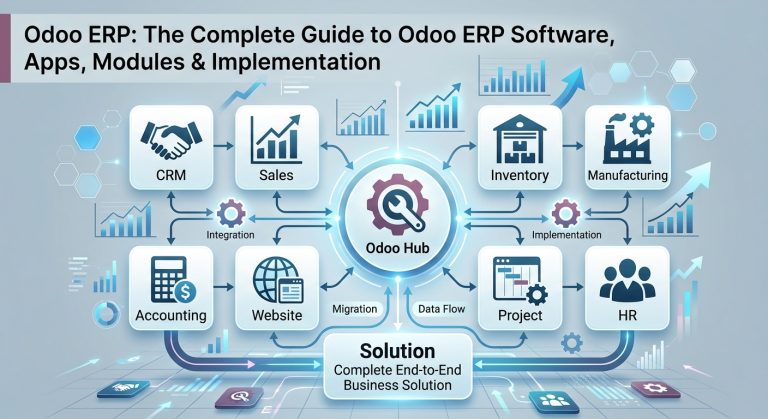
ERP (Enterprise Resource Planning) software is an integrated business management system that connects multiple departments and processes through a centralized platform.
Depending on the ERP solution, businesses can manage:
- Accounting and finance
- Sales and CRM
- Inventory and warehouse management
- Purchasing and suppliers
- Manufacturing
- Human resources
- Project management
- Supply chain operations
- Business reporting and analytics
The main advantage of ERP is integration. Instead of keeping business information in separate systems, an ERP can connect different departments and provide a unified view of operations.
For a broader explanation, see our guide: ERP Software in Bangladesh: Complete Guide to Features, Modules, Pricing & How to Choose.
What Is Accounting Software?
Accounting software is designed primarily to manage a company’s financial activities.
Common accounting features include:
- Invoicing
- Accounts payable
- Accounts receivable
- Expense tracking
- Bank reconciliation
- General ledger
- Tax management
- Financial statements
- Cash-flow tracking
- Financial reporting
Accounting software is often a good choice for freelancers, startups, small businesses, and organizations that mainly need financial management without complex operational requirements.
ERP vs Accounting Software: Key Differences
The biggest difference between ERP and accounting software is scope.
| Feature | ERP Software | Accounting Software |
|---|---|---|
| Accounting | ✅ | ✅ |
| Invoicing | ✅ | ✅ |
| Financial reporting | ✅ | ✅ |
| Inventory management | ✅ | Limited/Basic |
| Purchasing | ✅ | Limited |
| Sales management | ✅ | Limited |
| CRM | Often available | Usually limited |
| Manufacturing | ✅ | ❌ |
| HR management | Often available | Limited/❌ |
| Supply chain | ✅ | ❌ |
| Business-wide integration | ✅ | Limited |
| Advanced operational reporting | ✅ | Limited |
In simple terms:
Accounting software manages your finances.
ERP software manages your business operations, including finances.
ERP vs Accounting Software: Which Is Better?
There is no universal winner. The right choice depends on the size, complexity, and growth plans of your business.
Choose Accounting Software If:
Accounting software may be sufficient if your business:
- Mainly needs bookkeeping and financial reporting
- Has relatively simple operations
- Has limited inventory requirements
- Does not require manufacturing management
- Does not need multiple departments connected together
- Wants a simpler and lower-cost solution
For a small service-based business, for example, a dedicated accounting system may provide everything necessary.
Choose ERP Software If:
ERP becomes more valuable when a business has complex or interconnected operations.
Consider ERP if you need to manage:
- Multiple warehouses
- Large product catalogs
- Purchasing and supplier management
- Sales and inventory together
- Manufacturing
- Multiple business departments
- Complex approval workflows
- Multiple branches or locations
- Real-time business dashboards
- Integrated financial and operational data
The more interconnected your business processes become, the more valuable an ERP system can be.
ERP Accounting Module vs Standalone Accounting Software
One common misconception is that ERP software replaces accounting software entirely.
In reality, most modern ERP systems include a full accounting and finance module.
For example, when a customer places an order:
Sales Order → Inventory Update → Invoice → Payment → Accounting Entry → Financial Report
These processes can be connected automatically within an ERP system.
With separate software, businesses may need to transfer information between systems manually or through integrations.
Benefits of ERP Over Standalone Accounting Software
1. Centralized Business Data
ERP stores information from different departments in one centralized system.
This reduces duplicate data entry and helps employees work with consistent information.
2. Better Inventory Control
Accounting software may track inventory at a basic level, but ERP systems can provide more comprehensive inventory management.
Businesses can monitor:
- Stock levels
- Stock movements
- Warehouses
- Purchase orders
- Sales orders
- Reordering
- Product costs
3. Improved Business Visibility
ERP connects operational and financial data, allowing management to understand how different activities affect profitability and cash flow.
4. Process Automation
ERP systems can automate workflows such as:
Purchase → Receipt → Vendor Bill → Payment
or:
Sales Order → Delivery → Invoice → Payment
This reduces manual work and improves operational efficiency.
5. Scalability
A small business may start with accounting software, but growing companies often require additional capabilities.
ERP can provide a foundation for managing more complex operations as the business expands.
Is ERP More Expensive Than Accounting Software?
Generally, ERP implementation can cost more than basic accounting software because ERP covers a much broader range of business processes.
However, comparing only software prices can be misleading.
Businesses should also consider:
- Implementation costs
- Customization
- Employee training
- Data migration
- Integrations
- Maintenance
- Subscription or licensing fees
- Productivity improvements
The best solution is not necessarily the cheapest software. It is the system that provides the right capabilities without creating unnecessary complexity.
Can a Small Business Use ERP Software?
Yes. Small businesses can use ERP software, particularly when they have inventory, purchasing, sales, manufacturing, or multi-department operations.
However, a small business with only a few employees and simple financial requirements may not need a full ERP system.
The key question is not simply:
“How big is the business?”
Instead, ask:
“How complex are the business processes?”
A small manufacturing company may benefit from ERP more than a larger consulting company with simple operations.
ERP vs Accounting Software: Final Verdict
The choice between ERP and accounting software depends on your business requirements.
Choose accounting software when your primary requirement is financial management and your operations are relatively simple.
Choose ERP software when you need to connect accounting with inventory, sales, purchasing, manufacturing, HR, supply chain, or other business processes.
A simple way to remember the difference is:
Accounting Software → Financial Management
ERP Software → Integrated Business Management
For businesses planning to scale, integrating operations and finance through ERP can provide better visibility, automation, and control.
Frequently Asked Questions
Is ERP better than accounting software?
ERP is not automatically better. It is more comprehensive, while accounting software can be more appropriate for businesses with simple financial requirements.
Can ERP replace accounting software?
Yes. Most modern ERP systems include accounting and finance modules, allowing businesses to manage financial operations within the same platform.
Is QuickBooks an ERP?
QuickBooks is primarily accounting and financial management software rather than a full ERP system.
When should a business switch from accounting software to ERP?
Businesses should consider ERP when separate systems, manual data entry, inventory complexity, multiple departments, manufacturing, or rapid growth begin creating operational problems.
Can ERP and accounting software work together?
Yes. Businesses can integrate separate accounting and ERP systems, although an integrated ERP accounting module can eliminate the need for maintaining multiple systems.