ERP Software Pricing in Bangladesh: Complete Cost Guide
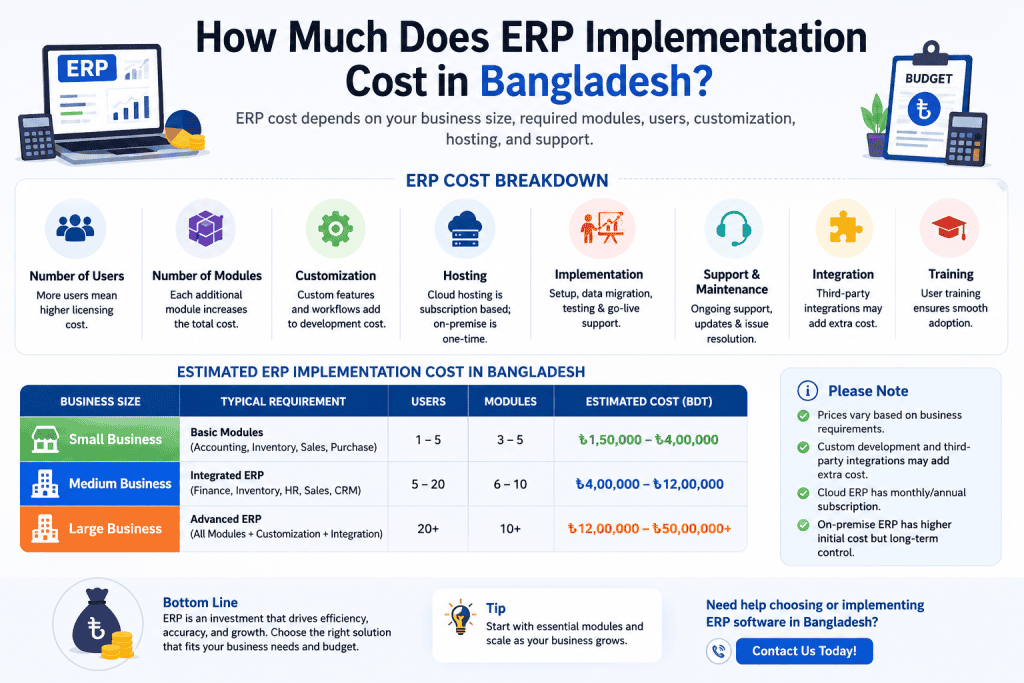
ERP software pricing in Bangladesh can vary significantly depending on the number of users, required modules, customization, implementation, hosting, integrations, training, and ongoing support. A small business may need only basic accounting and inventory features, while a growing company may require a complete ERP system covering sales, purchasing, HR, manufacturing, finance, CRM, and reporting.
This guide explains ERP software pricing in Bangladesh, the factors that affect ERP costs, common pricing models, and what businesses should consider before choosing an ERP solution.
What Is ERP Software Pricing?
ERP software pricing is the total cost a business pays to use, implement, customize, and maintain an ERP system.
The actual ERP cost is usually not limited to the software license. Businesses may also need to budget for:
- Software subscription or license
- ERP modules
- Number of users
- Implementation
- Customization
- Hosting
- Data migration
- Third-party integrations
- Employee training
- Technical support
- Maintenance and upgrades
Therefore, two businesses using the same ERP platform can have very different total costs.
How Much Does ERP Software Cost in Bangladesh?
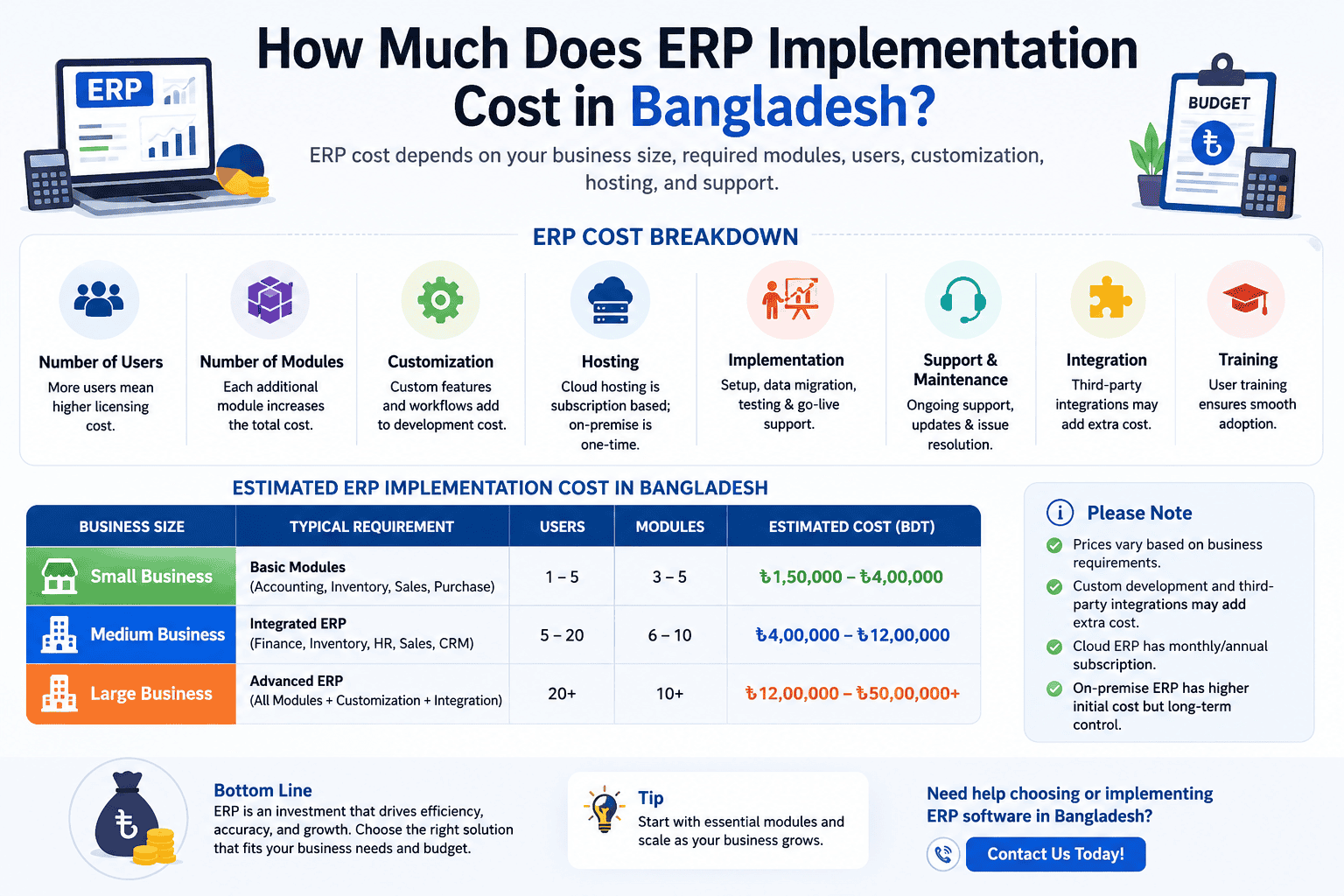
There is no single fixed price for ERP software in Bangladesh. The cost depends primarily on business size and requirements.
A general pricing structure may look like this:
| Business Type | Typical ERP Requirement | Main Cost Factors |
| Small Business | Accounting, Sales, Inventory | Users + basic modules |
| Medium Business | Integrated finance, sales, inventory, HR | Users + modules + implementation |
| Large Business | Full ERP with multiple departments | Customization + integrations + infrastructure |
| Manufacturing Business | Production, inventory, purchasing, accounting | Manufacturing modules + customization |
| Multi-Branch Business | Centralized operations and reporting | Users + branches + integrations |
These are general categories rather than fixed market prices. A proper quotation requires an assessment of the company’s workflows and technical requirements.
What Determines ERP Software Pricing?
Several factors can significantly affect the total cost of an ERP implementation.
1. Number of Users
Many ERP providers calculate pricing based on the number of users.
For example, an ERP system used by 5 employees will generally have a different cost structure from one used by 50 or 500 employees.
Before purchasing an ERP system, determine:
- How many employees need access?
- Which employees need full access?
- Which employees need limited access?
- Do managers require reporting dashboards?
- Will additional users be added later?
Choosing an ERP based only on today’s users can create problems when the business grows.
2. Number of ERP Modules
ERP systems are usually divided into different business modules.
Common ERP modules include:
- Accounting
- Sales
- Purchase
- Inventory
- CRM
- Human Resources
- Payroll
- Manufacturing
- Point of Sale
- Project Management
- Expense Management
- Reporting
A company that needs only accounting and inventory will usually have a lower implementation scope than a company requiring a complete ERP solution.
3. ERP Customization
Customization is another major factor in ERP software pricing in Bangladesh.
Businesses often need modifications because their existing workflows do not exactly match the standard ERP system.
Customization may include:
- Custom reports
- Custom dashboards
- Approval workflows
- New fields
- Automated processes
- Custom invoices
- Bangladesh-specific business requirements
- Industry-specific features
The more customization required, the higher the overall implementation cost is likely to be.
4. ERP Implementation Cost
ERP implementation includes configuring the system and making it ready for real business operations.
Implementation may involve:
- Business requirement analysis
- ERP configuration
- User setup
- Module configuration
- Data migration
- Custom development
- Testing
- Employee training
- Deployment
- Post-launch support
Implementation should be treated as a separate cost from the software subscription or license.
5. Cloud ERP Hosting Cost
Cloud ERP systems are hosted on remote servers and accessed through the internet.
Depending on the ERP provider, hosting may be included in the subscription or charged separately.
Cloud ERP can reduce the need for businesses to purchase and maintain their own server infrastructure.
However, businesses should check:
- Hosting provider
- Server specifications
- Backup policy
- Security
- Data storage
- Server location
- Uptime
- Disaster recovery
6. On-Premise ERP Cost
With an on-premise ERP system, the business typically manages its own server infrastructure.
The initial investment may include:
- Server hardware
- Networking equipment
- Operating system
- Database infrastructure
- Security
- Backup systems
- IT administration
Although on-premise ERP can provide greater infrastructure control, it may require higher upfront investment and ongoing technical management.
7. ERP Integration Cost
Modern businesses often need ERP integration with other systems.
Examples include:
- Payment gateways
- eCommerce websites
- POS systems
- Banking systems
- SMS platforms
- Email services
- Shipping platforms
- CRM systems
- Business websites
Each integration can add development and maintenance costs depending on the complexity of the API and data flow.
8. Data Migration Cost
Moving existing business data into a new ERP system can require significant preparation.
Data may come from:
- Excel files
- Existing accounting software
- Legacy ERP systems
- POS systems
- Databases
Data migration may involve cleaning, restructuring, validating, and importing information.
Typical migration data includes:
- Products
- Customers
- Suppliers
- Opening balances
- Inventory
- Sales history
- Purchase history
- Employee information
Poor-quality data can increase migration time and implementation costs.
9. Employee Training
ERP implementation is not successful simply because the software has been installed.
Employees need to understand how to use the new system correctly.
Training may cover:
- Accounting operations
- Sales workflows
- Inventory management
- Purchasing
- HR processes
- Reporting
- User permissions
Training costs depend on the number of employees, training sessions, and complexity of the ERP system.
10. Support and Maintenance Cost
ERP software requires ongoing support after implementation.
Maintenance may include:
- Bug fixing
- Software updates
- Security updates
- Database maintenance
- Backup management
- Performance optimization
- User support
- Additional customization
Businesses should ask about annual support and maintenance costs before signing an ERP agreement.
ERP Pricing Models in Bangladesh
ERP providers may use different pricing models.
Subscription-Based ERP
Businesses pay a recurring monthly or annual fee.
The price may depend on:
- Number of users
- Selected modules
- Hosting
- Support level
- Storage
This model is common with cloud ERP solutions.
One-Time License ERP
The business pays an upfront license fee for the software.
However, implementation, customization, hosting, support, and maintenance may still be charged separately.
Custom ERP Development
Some businesses choose to develop an ERP system specifically for their workflows.
This can provide greater flexibility but may require a larger initial investment.
Custom ERP development costs depend heavily on:
- Number of modules
- Development time
- User requirements
- Integrations
- Custom workflows
- UI/UX requirements
- Maintenance requirements
Estimated ERP Cost Structure for Businesses in Bangladesh
Instead of focusing only on the software price, businesses should calculate the Total Cost of Ownership (TCO).
A simple model is:
For example, a business may purchase an ERP subscription at a relatively low monthly price but spend significantly more on customization and implementation.
Therefore, comparing ERP solutions only by monthly subscription price can be misleading.
Free ERP vs Paid ERP
Free ERP software can be attractive for startups and small businesses because it may reduce initial software costs.
However, “free” does not always mean zero total cost.
Businesses may still pay for:
- Hosting
- Implementation
- Customization
- Support
- Training
- Development
- Maintenance
Paid ERP solutions may provide additional services, professional support, hosting, security, updates, and advanced functionality.
The better choice depends on business requirements rather than software price alone.
How to Choose ERP Software Based on Your Budget
Before selecting an ERP, define your budget around business requirements.
Small Businesses
A small business may start with essential modules such as:
- Accounting
- Sales
- Purchase
- Inventory
Avoid paying for complex modules that the business does not currently need.
Medium-Sized Businesses
Medium businesses may require:
- Accounting
- Inventory
- Sales
- Purchase
- CRM
- HR
- Payroll
- Reporting
Integration and workflow automation become more important as the business grows.
Large Businesses
Large organizations may require:
- Multiple branches
- Advanced financial management
- Manufacturing
- Supply chain management
- HR and payroll
- Advanced reporting
- Third-party integrations
- Custom workflows
For larger businesses, scalability and implementation capability can be more important than the initial software price.
Questions to Ask an ERP Provider Before Buying
Before choosing an ERP provider in Bangladesh, ask:
- What is included in the ERP price?
- Is pricing based on users or modules?
- Is hosting included?
- What is the implementation cost?
- How much does customization cost?
- Are integrations included?
- Is data migration included?
- Is employee training included?
- What is the annual support cost?
- Are software updates included?
- What happens when the number of users increases?
- Can the ERP scale with the business?
These questions can help prevent unexpected costs later.
Common Mistakes When Comparing ERP Prices
Choosing the Cheapest ERP
The cheapest ERP is not necessarily the most cost-effective solution.
A low-cost system may lack important features or require expensive customization later.
Ignoring Implementation Costs
Businesses sometimes compare subscription prices while ignoring implementation expenses.
This can create an unrealistic budget.
Buying Too Many Modules
Purchasing unnecessary modules increases complexity and cost.
Start with the modules that solve your most important business problems.
Not Considering Scalability
An ERP should support future growth.
If adding users, branches, or modules becomes extremely expensive, the initial low price may not provide good long-term value.
How to Reduce ERP Implementation Costs
Businesses can control ERP costs by:
- Clearly defining requirements before implementation
- Starting with essential modules
- Avoiding unnecessary customization
- Cleaning data before migration
- Training key employees early
- Choosing scalable hosting
- Planning integrations carefully
- Comparing total cost of ownership instead of only subscription price
A phased ERP implementation can also help businesses spread costs over time.
ERP Software Pricing: What Should Businesses Focus On?
The right question is not:
“Which ERP software is the cheapest?”
A better question is:
“Which ERP solution provides the best value for our business requirements?”
An ERP system should reduce manual work, improve data accuracy, connect departments, automate processes, and provide better visibility into business performance.
If a slightly more expensive ERP saves significant time and reduces operational errors, it may deliver a better return on investment.
Final Thoughts
ERP software pricing in Bangladesh depends on many factors, including users, modules, customization, implementation, hosting, integrations, training, and support.
Small businesses may start with a basic ERP setup, while growing and larger organizations may require a more comprehensive solution.
Before making a decision, compare the total cost of ownership, scalability, functionality, implementation expertise, and long-term business value—not just the advertised software price.
If you are researching ERP solutions for your business, you can also explore our complete guide to ERP Software in Bangladesh, including ERP features, modules, implementation, pricing, and how to choose the right solution.